


Past Meetings
Gospels and Philosophy
With considerable success, FoSPRA hosted the Workshop “Gospels and Philosophy: Fresh Perspectives on the Gospels and Ancient Modes of Doing Philosophy” at the University of Bonn on 5 October 2026, bringing together scholars from Bonn and abroad for a full day of discussion on the relationship between early Christian texts and ancient philosophical traditions.
The programme opened with George van Kooten’s keynote on “The Gospels as Greek Literature,” followed by a response from Athanasios Despotis. Further papers explored love in Platonism, Philo, and the Fourth Gospel, Antiochian exegesis and the philosophical portrayal of Jesus, and apophatic Christology in Pseudo-Dionysius. Participants exchanged ideas on how to consolidate the forum on a more permanent basis and expand its activities through additional formats and initiatives, offering concrete suggestions for future collaboration, events, and forms of scholarly exchange.
Held in hybrid format and concluding with a general discussion, the workshop created a focused setting for exchange across New Testament studies, patristics, and ancient philosophy. It also highlighted FoSPRA’s continuing effort to connect scholars working at the intersection of religion and philosophy in Late Antiquity across different academic traditions and institutions.


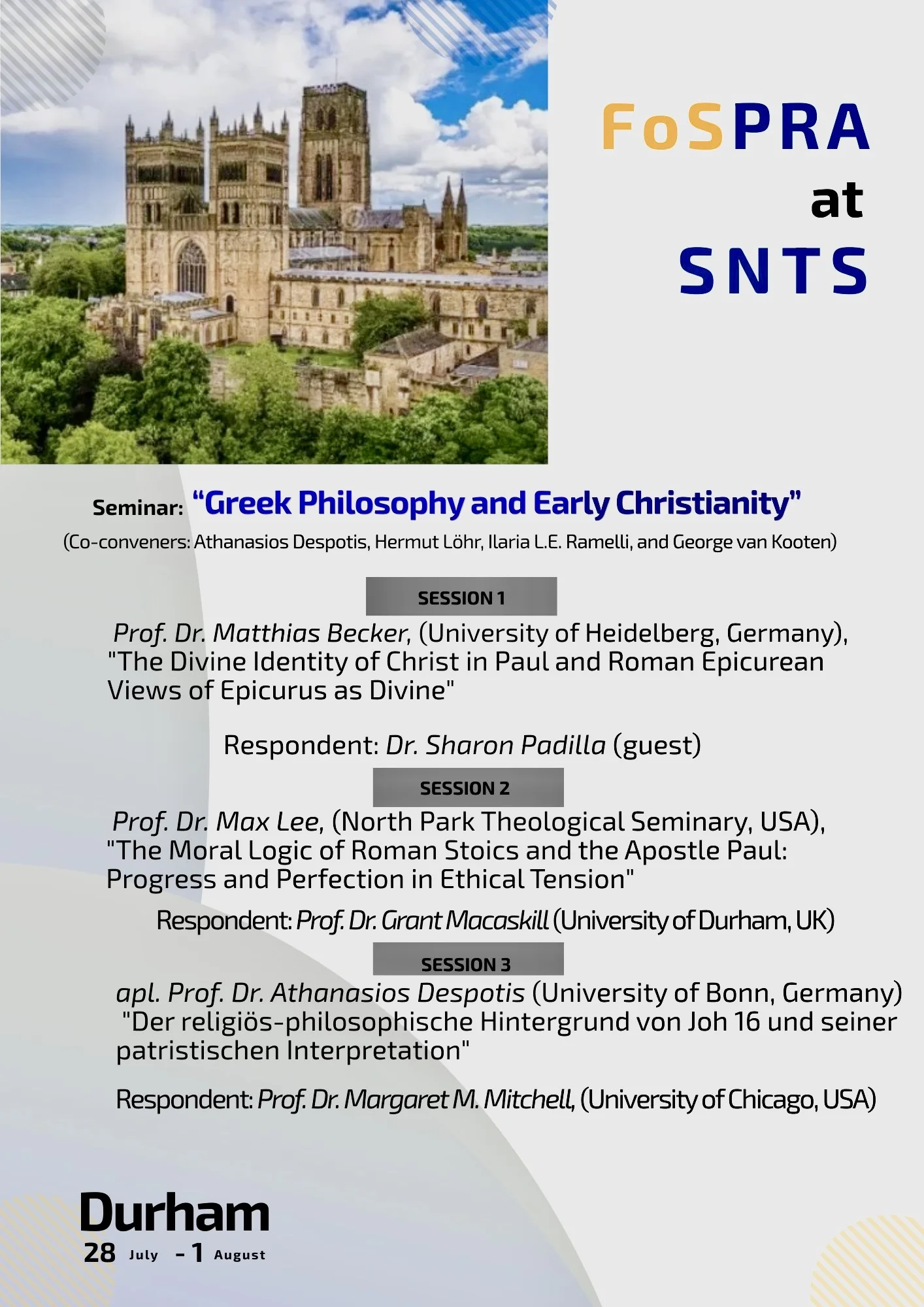
Greek Philosophy and Early Christianity
At the 2026 SNTS Annual Meeting in Durham (28 July–1 August), FoSPRA hosted a seminar on “Greek Philosophy and Early Christianity”, convening scholars at the intersection of ancient philosophy and early Christian thought.
Across three well-attended sessions, Matthias Becker, Max Lee, and Athanasios Despotis presented papers—complemented by responses from Sharon Padilla, Grant Macaskill, and Margaret M. Mitchell—covering topics from Stoic ethics and Roman Epicureanism to Pauline theology and the patristic reception of John 16.
The meeting provided a vibrant forum for academic exchange and further strengthened FoSPRA’s international network within New Testament and early Christian studies. Looking ahead, participants agreed to center next year’s seminar on the theme “Philosophical Discourses of Eschatology.”
Paradeigmata Voluntatis: Ancient Concepts of Will
From 9–11 July 2026, FoSPRA hosted succesfully the international conference Paradigmata Voluntatis: Ancient Concepts of Will at the Impulse House in Bonn. The three-day event brought together leading international scholars to examine the development of the concept of will across the ancient Near East, Greek philosophy, Hellenistic Judaism, and early Christianity.
Participants explored methodological as well as conceptual questions concerning the emergence and transformation of the notion of will, highlighting the importance of approaching these traditions within their broader intellectual and cultural contexts.
The conference proved to be a highly stimulating scholarly gathering, further strengthening FoSPRA’s international network and reaffirming its commitment to promoting innovative research at the intersection of philosophy and religion in antiquity.


Eight Modes, One Soundscape: Byzantine Music Between Spirituality and Philosophy
On Friday, June 5, 2026, the concert "Eight Modes, One Soundscape: Byzantine Music Between Spirituality and Philosophy" was held at the Schlosskirche of the University of Bonn, drawing a large audience. The event was honoured by the presence of the Rector of the University of Bonn, Michael Hoch, the representative of the Greek Orthodox Metropolis of Germany and Bishop of Argyroupolis Ambrosios of Argyroupolis, university professors, and other guests. Led by apl. Prof. Dr. Athanasios Despotis, the ensemble of the Bonner Melodia e.V. association performed selected hymns from all eight modes, alongside traditional Greek songs about the fall of Constantinople. The concert was preceded by a brief speech by Dr. Nestor Kavvadas, who demonstrated the philosophical background of the Byzantine Oktoechos (eight-mode system) and specifically that of the "wheel" (trochos). Particular emphasis was placed on the spiritual and anagogical significance of music for ancient philosophers as a means of purifying the soul and uniting with God.
Visit our YouTube channel to enjoy selected excerpts from the concert.


Philosophical Ambiguity: Enigmatic Language in Religious-Philosophical Discourses of Antiquity
On May 21, 2026, the hybrid seminar presentation "Philosophische Ambiguität: Rätselhafte Sprache in religiös-philosophischen Diskursen der Antike und im Markusevangelium" took place, featuring PhD candidate Alexander-Maximilian Gialousis (New Testament, KTF).
With considerable success, Gialousis presented his compelling proposal for reading the Gospel of Mark through the lens of ancient philosophical discourses on ambiguous language. He had circulated a well-crafted chapter from his dissertation in advance and complemented it in the session with a concise PowerPoint presentation.
The ensuing discussion opened up new perspectives on ambiguity as a constructive rhetorical strategy, one that actively engages the reader in a deeper understanding of Jesus’ words and of the Markan narrative in relation to contemporary philosophical debates.

Inaugural Event
The International Forum for the Study of Philosophy and Religion (FoSPRA) successfully held its inaugural event on 28 April 2026 at the Impulse House, Adenauerallee 131, Bonn. The hybrid meeting brought together more than 50 participants in person, along with distinguished international attendees via Zoom, including renowned senior and early-career scholars such as Professors George Boys-Stones (Toronto), Isidoros Katsos (Athens), Eleni Mathiou (Mexico City), Matthias Haake (Oxford), and Clelia Attanasio (Rome).
The event explored important dimensions and intersections between religion and philosophy, fostering a rich landscape of engagement and interdisciplinary dialogue. The program moved from a review of past events, conferences, publishing projects, and seminars to a strategic vision for ongoing research and future initiatives, also addressing the importance of fundraising for the Forum’s growth and development. Special attention was given to the existing ERASMUS+ co-operation between the universities of Athens and Bonn via exchanges of students and staff members, as Professor Katsos highlighted the need for deepening relationships.
A significant aspect of the gathering was the active participation and exchange of ideas, such as the reconsideration of body-soul dualism and fideistic approaches, as well as the prospect of developing the initiative into an established international forum that will strengthen existing networks at the University of Bonn, the Society of Biblical Literature, and the Society of New Testament Studies. It was a genuinely stimulating event, highlighting FoSPRA’s potential to develop into a leading hub for cross-cultural and interdisciplinary intellectual exchange in the field of religion and philosophy.

